
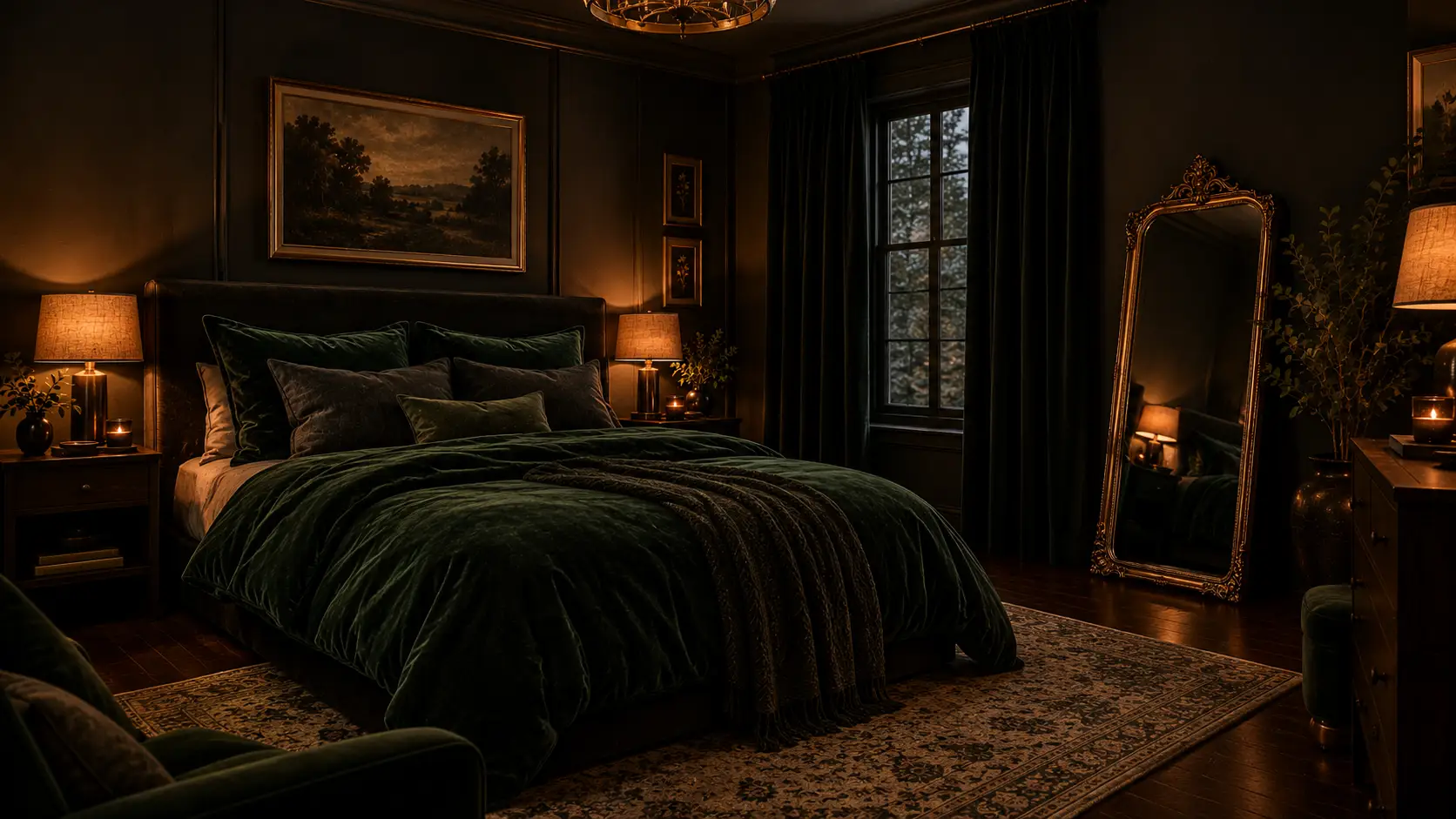
Thinking about taking your room dark feels incredibly risky. You want a dramatic, sophisticated retreat, but you’re absolutely terrified it will just end up looking like a depressing cave or a messy teenager’s dungeon. I get it. I felt the exact same fear before I finally committed to the dark side in my own home. That hesitation is normal because standard decorating rules tell you to keep everything bright and airy to make it feel ‘clean.’ But if your goal is a deeply relaxing, hotel-quality escape where you can actually unplug, standard bright-and-airy rules fail every time.
This guide walks you through five definitive moody bedroom ideas that guarantee a cohesive, rich finish without requiring a professional designer. We will strip away the glare, use textures to create depth, and swap harsh lighting for the warm glow of intimate shadows. The entire hands-on work takes less than one weekend.
Stop staring at paint chips, gather your tools, and let’s finally give you that dramatic, intimate sleep sanctuary you deserve.
Paint your walls, baseboards, and doors the exact same dark color.
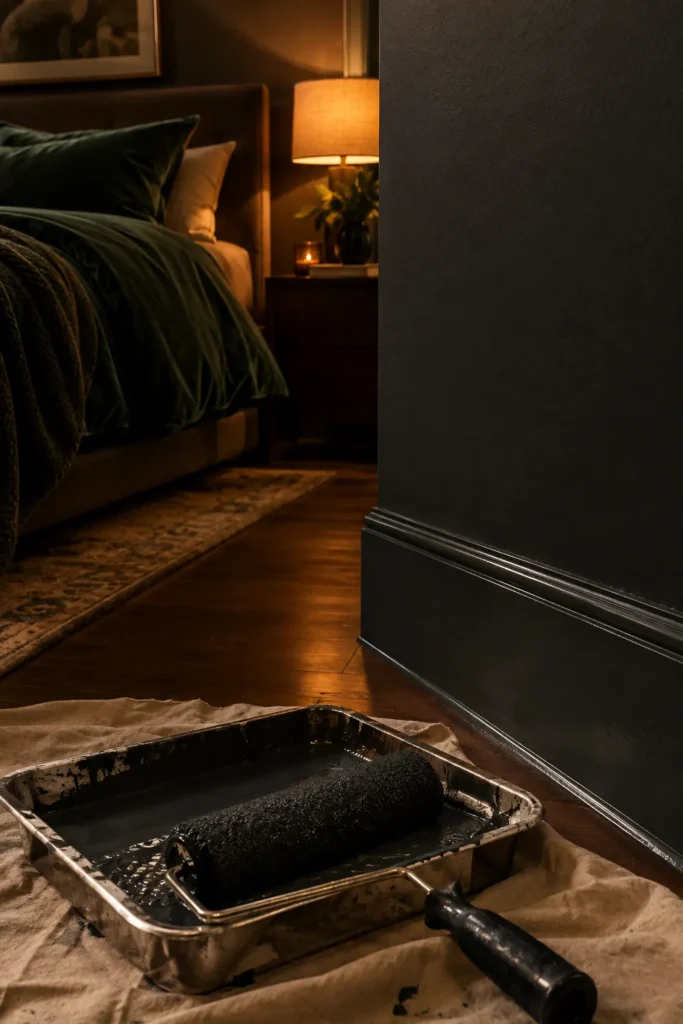
Most moody bedroom ideas fail before the paint dries because beginners leave the standard white trim in place. When you have stark white baseboards and window casings cutting through a rich, dark wall color, you are visually outlining the entire room’s footprint. That contrast draws the eye downward, highlights exactly how small the space is, and creates a harsh visual frame that breaks the moody illusion instantly.
Instead, use the same high-quality flat or eggshell finish paint on the drywall, and the coordinating semi-gloss trim paint in the exact same shade on the wooden baseboards, casings, and the back of your bedroom door.
Swap your crisp cotton bedding for heavy velvet and washed linen layers.
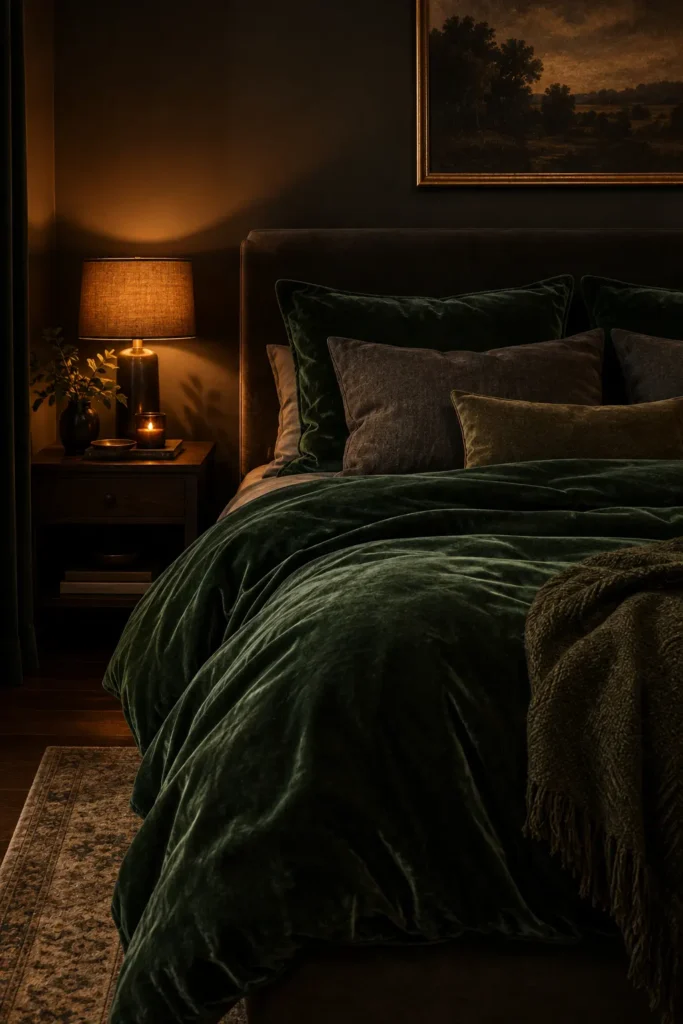
Raw, heavy texture is the mandatory second layer required to prevent a dark room from feeling like a flat, depressing cave. Your smooth, crisp cotton sheets, which felt so refreshing in a bright white room, will look thin and cold against dramatic charcoal or deep navy walls. We need materials that absorb and soften light rather than reflecting it. Start with a heavy, matte velvet duvet cover or quilt as your main top layer, then layer in washed linen Euro shams and perhaps a chunky, textured wool throw blanket at the foot of the bed.
- Select deep, saturated tones like forest green, charcoal, or plum.
- Avoid any shiny synthetics; you want matte velvet.
- Mix at least 2 different textures (e.g., velvet duvet + linen pillow shams).
Hang thick blackout curtains just two inches below the ceiling line.
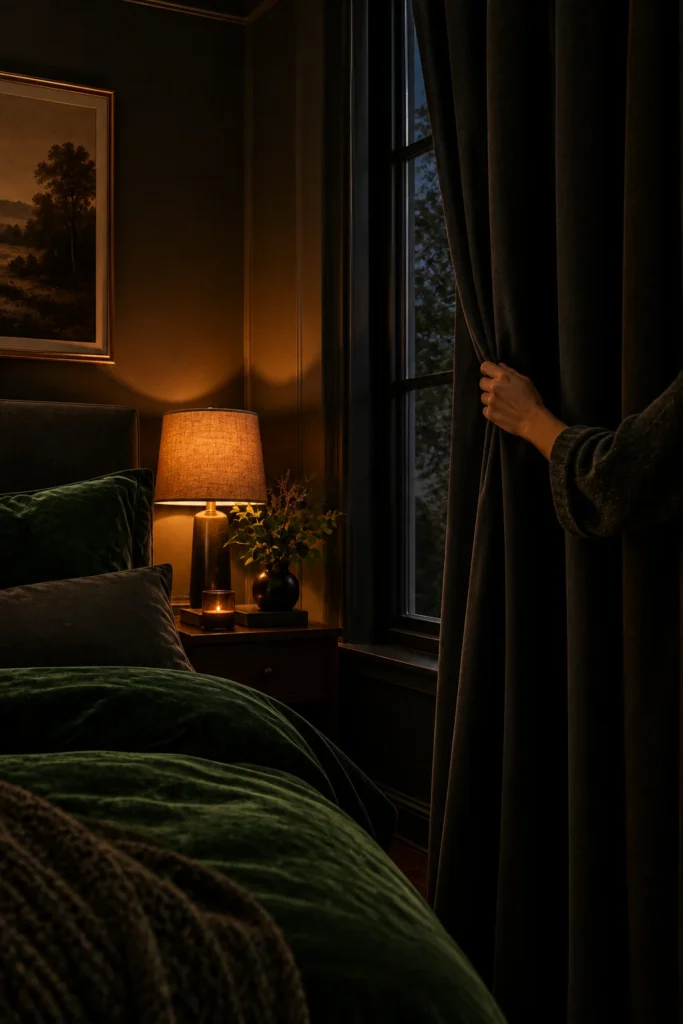
To achieve that dreamy, cocoon-like atmosphere, you must have total control over all light ingress. If you use cheap, thin curtains, the sunlight will bleed through, exposing every bit of visual clutter and making the dark walls look weak and sallow during the day. Mount your curtain brackets exceptionally high—no more than 2 inches below your crown molding or ceiling line—and widen the rod by 8 inches past the window frame on both sides.
This height trick visually stretches the wall, and the width allows the heavy fabric to rest against the drywall when open, maximizing the window itself.
Install warm, low-wattage amber bulbs in all your bedside fixtures.
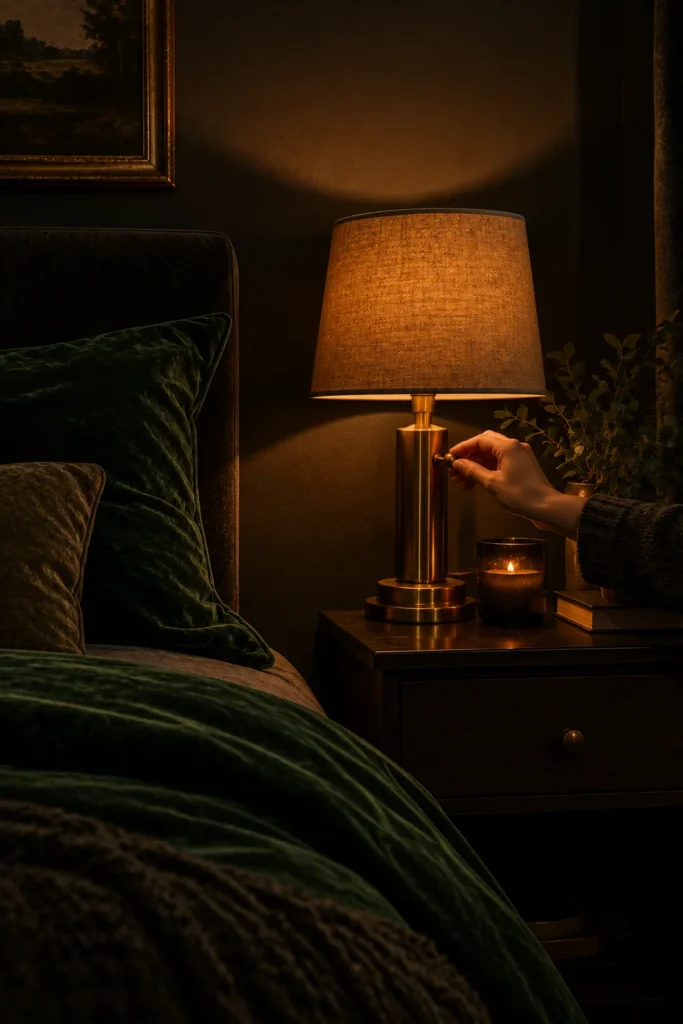
Harsh, downward-facing overhead light destroys a moody aesthetic faster than anything else. Flipping on a primary ceiling fixture creates a flat, interrogated look that completely erases the cozy, intimate shadows you built with the dark paint and heavy textiles. Turn off your main bedroom switch permanently. Instead, you will rely entirely on bedside table lamps, wall sconces, and floor lighting to create soft pools of illumination.
- Unscrew all existing cool-toned or “daylight” bulbs from your lamps.
- Replace them with dim, 40-watt equivalent LED bulbs.
- Verify the packaging says the color temperature is exactly between 2000K and 2700K.
Prop a large vintage-style floor mirror in the darkest corner of the room.
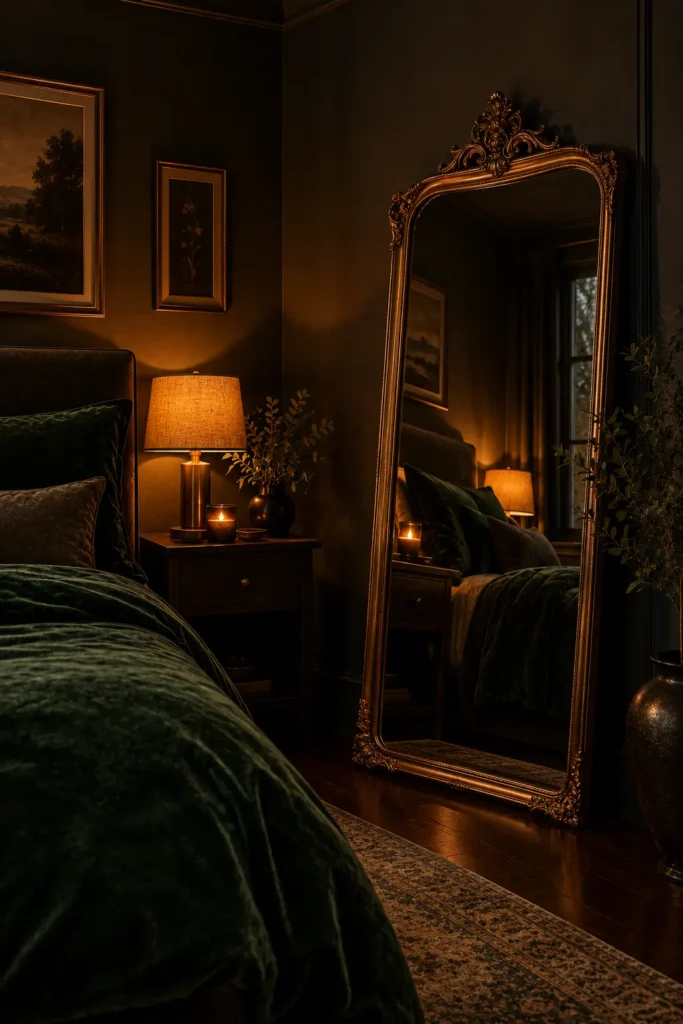
Absorbing too much light makes a confined space feel suffocating rather than relaxing. You need a large reflective surface to bounce whatever soft, warm ambient light you have left back into the center of the room. A towering, ornate floor mirror does this perfectly while introducing a hard, metallic texture that contrasts beautifully against the matte walls and soft velvet bedding. Find the corner furthest from your window and lean a heavy, framed mirror—at least 65 inches tall—directly against the drywall.
Pro Tip: Always Test in the Shadows
Never commit to a moody paint color based on a tiny store swatch. Dark colors shift drastically depending on the time of day and your artificial lighting. Always paint a large 2×2 foot test patch on multiple walls and observe it under your warm amber bulbs before buying the full gallon.
Conclusion
You successfully turned a basic, bright box into a highly intentional dark escape. Executing these 5 moody bedroom ideas proves that committing to deep colors and heavy textures creates the ultimate sleep sanctuary. The hard work is over, so go grab a good book, turn on your amber lamps, and enjoy the relaxing shadows. Pin this guide to your favorite home decor board so you have the exact steps ready for your next weekend room makeover!
FAQ
Won’t a dark ceiling make the room feel smaller?
No. Painting the ceiling the same dark color as the walls actually blurs the edges of the room, making it impossible for your eye to see where the walls stop and the ceiling begins. This trick mimics the infinite night sky.
Can I do this if my bedroom does not get natural light?
Yes. Moody rooms actually thrive in low-light situations. Instead of fighting the lack of sunlight with white paint that ends up looking gray and dingy, embracing a dark color makes the shadows feel highly intentional.
Should I paint my window frames dark too?
Yes, paint the window sashes and casings the exact same dark color as the walls. Leaving them white creates a harsh, distracting frame around the glass that ruins the cohesive look of the space.