
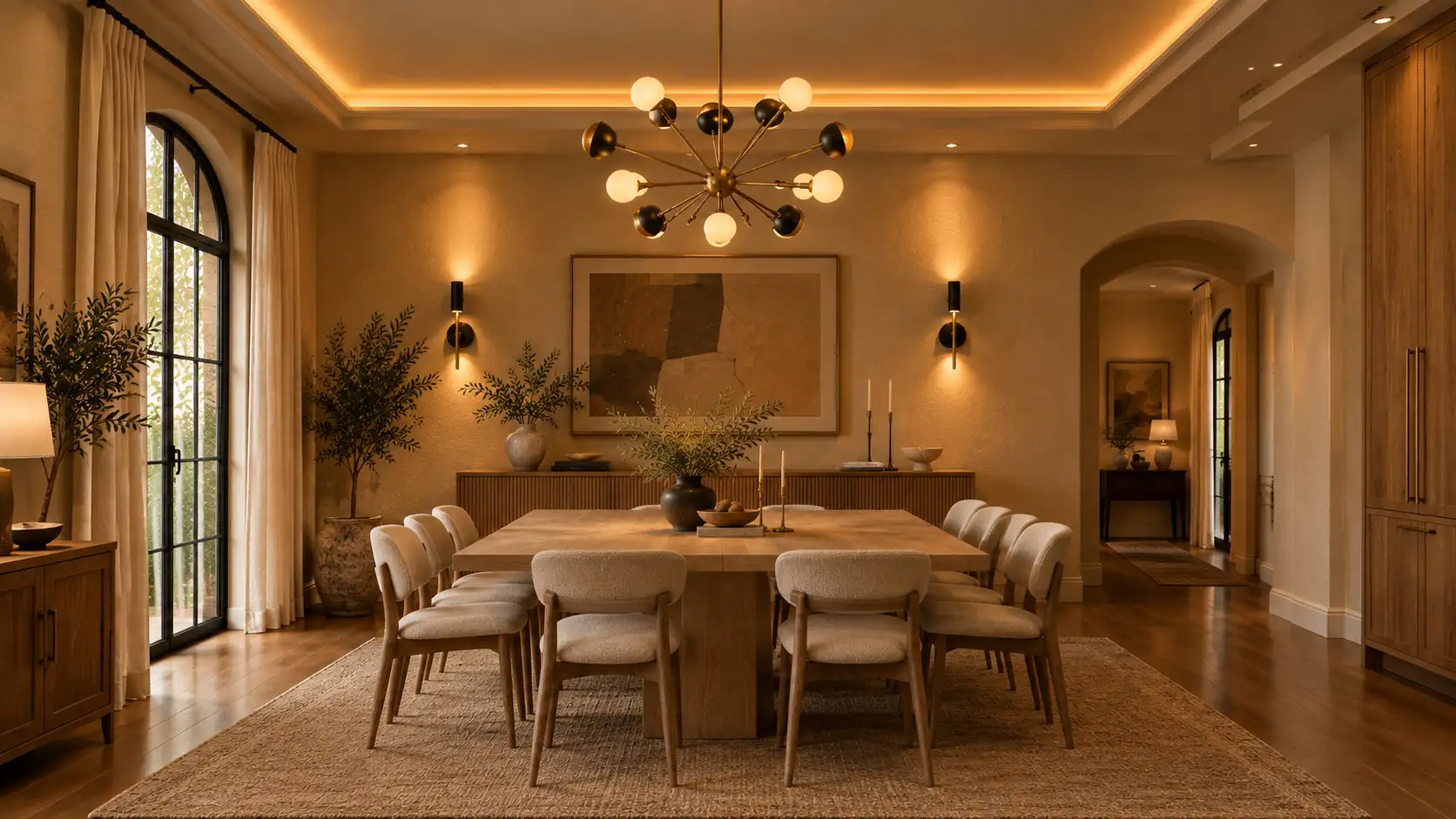
A poorly lit dining space flattens room architecture, causes harsh glare, or casts distracting shadows across dinner plates. Striking a balance between functional illumination and an inviting atmosphere requires a deliberate layout strategy rather than reliance on a single overhead fixture.
Effective illumination layers ambient warmth, focused task brightness, and subtle architectural highlights. Implementing the right combination of fixtures turns an ordinary eating area into a refined space designed for entertaining.
Whether remodeling a formal space or updating an open-concept layout, testing practical dining room lighting ideas provides a roadmap for proper fixture selection, correct hanging heights, and color temperature control.
Anchor the Space with Statement Dining Room Lighting Ideas
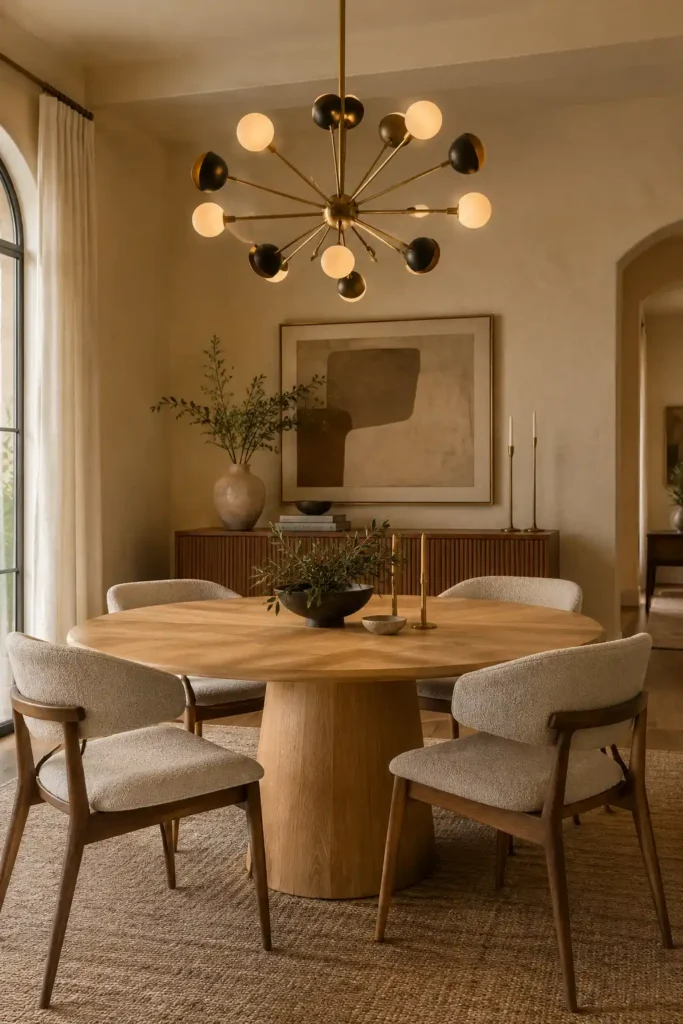
A central chandelier serves as both a primary illumination source and a visual focal point that locks the dining table into the overall room layout. Choosing the correct scale prevents large fixtures from overpowering small tables or compact units from looking lost in open rooms.
Calculate fixture proportions using room measurements. Add the room length and width in feet, then convert that total to inches to find the ideal fixture diameter. For instance, a 12-foot by 14-foot dining room requires a chandelier measuring roughly 26 inches across.
Suspension depth requires precise measurement. Position the lowest point of the chandelier 30 to 36 inches above the tabletop when working with standard 8-foot ceiling heights.
Pro Tip: Balancing Chandelier Width
Ensure your chandelier width measures 1/2 to 2/3 the total width of your dining table to maintain sightlines across the room.
Install Linear Pendants Over Rectangular Tables
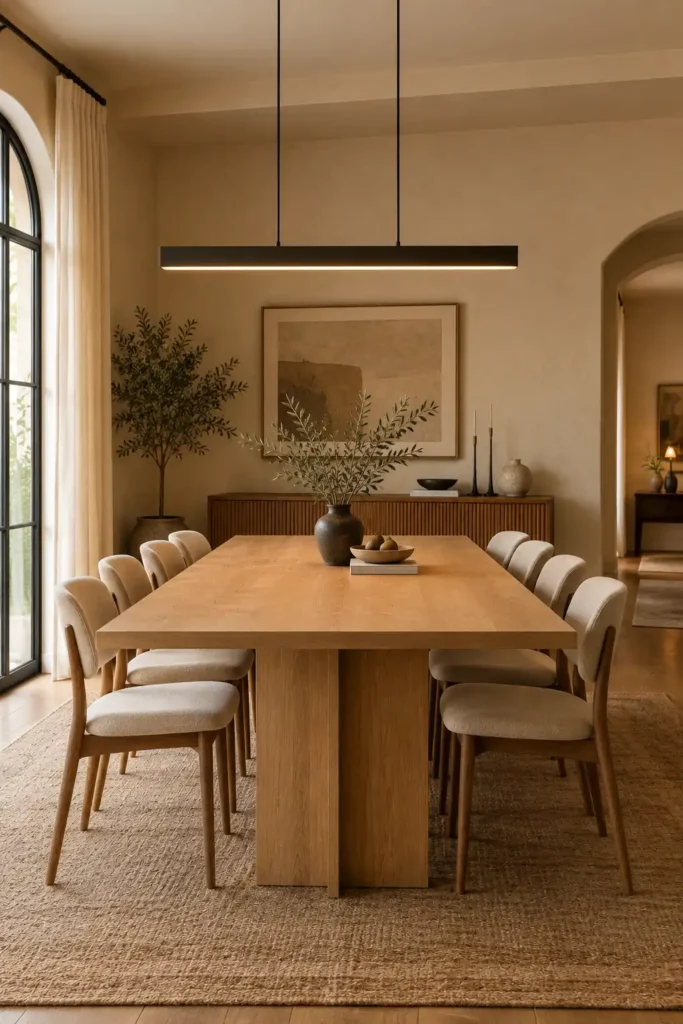
Long dining tables create coverage challenges for traditional round chandeliers, often leaving the outer ends of the table in darkness. Linear pendants solve this by spreading light evenly along the horizontal axis.
Select linear fixtures that span 60% to 70% of the total table length. Centering the fixture ensures the outer 15 to 20 inches of tabletop edge receive equal foot-candle coverage.
When choosing between multi-pendant clusters or single-beam fixtures, consider your preferred aesthetic and functional goals:
- Single-beam LED fixtures: Integrated linear profiles delivering 1200 to 1800 lumens of downward beam coverage.
- Multi-bulb cluster drops: 3 to 5 individual hanging pendants mounted to a single canopy, spaced 12 inches apart.
- Artisanal timber suspensions: Solid wood housings holding exposed warm filament LEDs rated at 2700K.
Hang linear fixtures at 32 inches above the surface to keep light beams broad while preserving unobstructed views across the table.
Mount Wall Sconces to Build Warm Ambient Layers
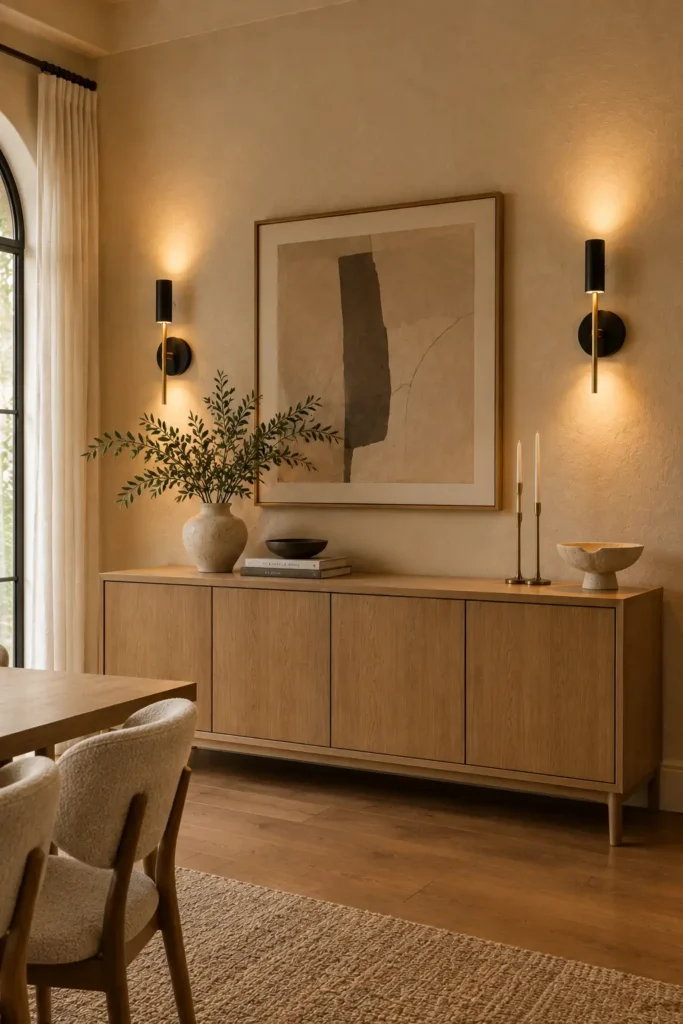
Relying exclusively on overhead lighting creates harsh shadows beneath eyes and noses. Wall sconces provide essential horizontal illumination that softens room perimeters and balances bright central lights.
Mount perimeter sconces at eye level, approximately 60 to 66 inches from the finished floor. If placing sconces along a feature wall, space them 6 to 8 feet apart to maintain balanced light distribution.
Positioning sconces alongside a sideboard or buffet table offers functional accent lighting for serving dishes during social gatherings.
Pro Tip: Matching Sconce Output
Select sconce bulbs with a 2700K color temperature outputting 400 lumens per fixture to eliminate perimeter shadows without competing with your central fixture.
Position Recessed Can Lights to Eliminate Harsh Shadows
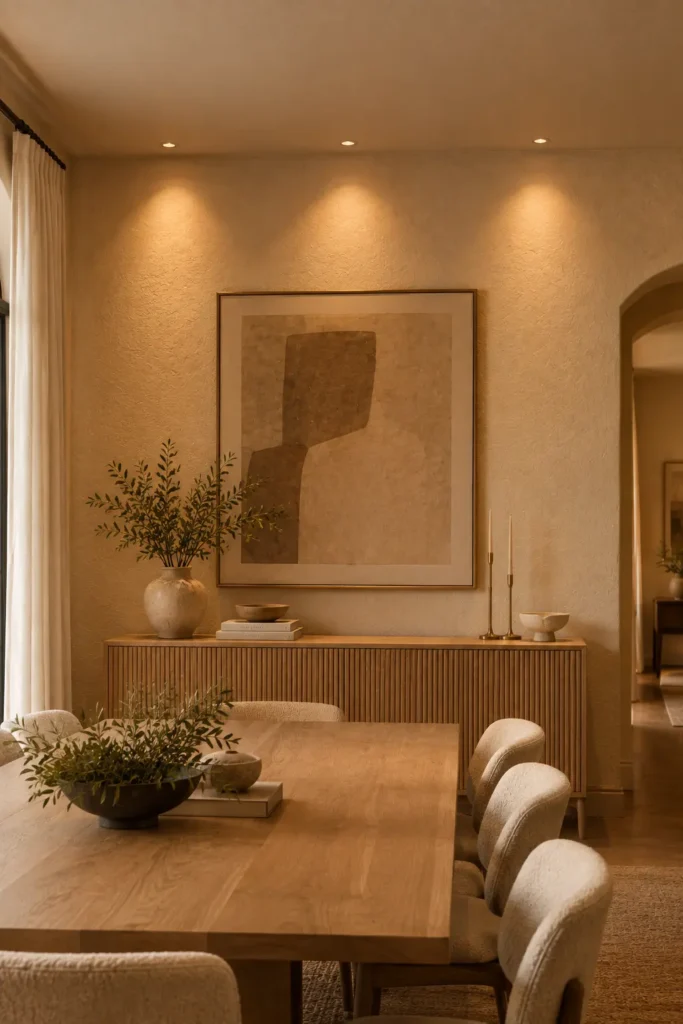
Architectural downlighting supplements decorative central fixtures by filling dark corners and highlighting artwork, wallpaper textures, or accent furniture.
Avoid grid-style placement directly above dining chairs, as overhead downlights cast unflattering shadows on faces. Instead, position recessed fixtures 24 to 36 inches off wall perimeters to angle light onto display surfaces.
Using adjustable architectural trims allows precise beam direction:
- 3-inch or 4-inch gimbal trims: Direct targeted 30-degree light beams straight onto artwork or floating shelves.
- Deep-regressed housings: Hide the light source within the ceiling casing to cut visible glare by 45%.
- Warm-dim technology: Automatically shifts color output from 3000K bright light down to a cozy 2200K amber tone as current decreases.
Incorporate Dimmable LED Cove Lighting for Perimeter Warmth
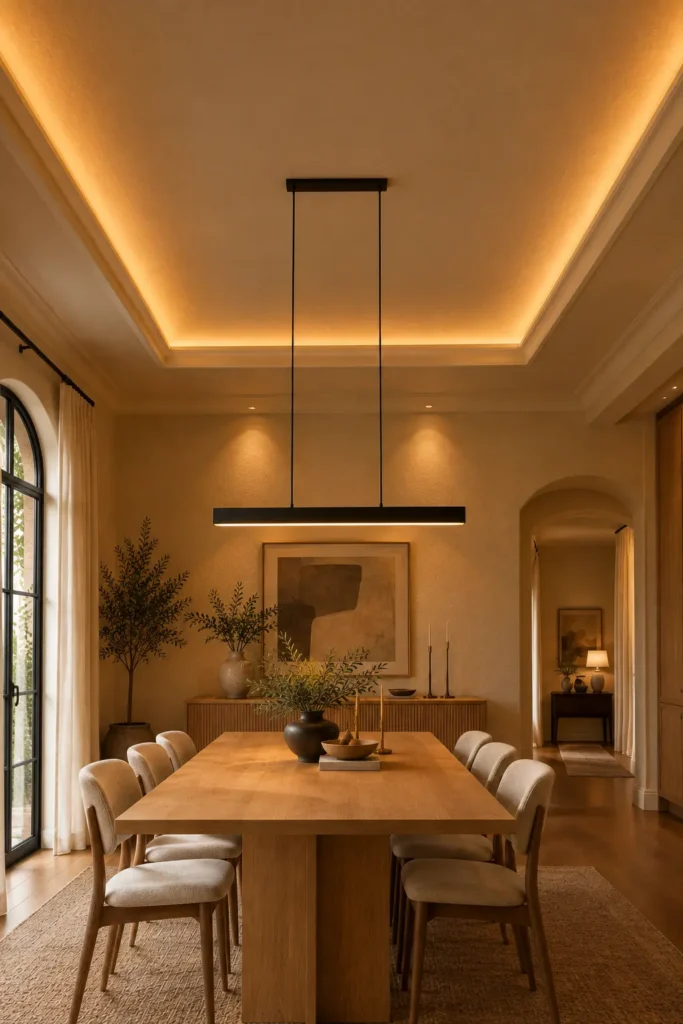
Indirect cove lighting installed inside ceiling trays or behind crown molding bounces soft light off ceiling planes, making room ceilings feel higher.
Specify LED linear tape producing 300 to 500 lumens per linear foot. Look for an engine color rendering index (CRI) of 90+ to ensure wall paint and wood finishes retain their true tones.
Concealing strip drivers inside accessible wall access panels keeps maintenance simple while preserving clean ceiling reveals.
Pro Tip: Strip Voltage Selection
Select 24-volt DC LED strip lights instead of 12-volt models to prevent voltage drops across continuous runs longer than 16 feet.
Calculate Exact Fixture Height and Scale for Dining Room Lighting Ideas
Installing fixtures at incorrect heights disrupts room balance and blocks view lines across the table.
Start with a baseline clearance of 30 inches measured from the bottom of the fixture shade to the table surface for an 8-foot ceiling. Add 3 inches of height for every additional 1 foot of ceiling elevation. For a 10-foot ceiling, position the bottom edge of the central pendant 36 inches above the table.
Calculating output requirements involves measuring room square footage. Multiply room length by room width to establish area, then multiply by 30 to 40 lumens per square foot. A 12-foot by 15-foot room (180 square feet) requires a combined output of 5,400 to 7,200 lumens distributed across all lighting layers.
Deploy Smart Dimmers to Control Lighting Scenes
Connecting all dining room fixtures to a single wall switch limits room usability. Installing dedicated multi-zone dimming controls allows independent adjustment of central pendants, accent sconces, and architectural downlights.
Lower main overhead fixtures to 20% output during evening dinner parties while keeping wall sconces at 40% to generate soft perimeter warmth. Raise all zones to 100% output for cleanups or daytime tasks.
Upgrading to smart switches compatible with home automation apps lets users program scene presets that activate instantly with one tap.
Conclusion
Building a well-balanced dining room layout requires combining task, ambient, and accent fixtures into a cohesive system. Selecting proper fixture proportions, hanging central pieces at precise heights, and controlling brightness through dimmable controls ensures your space remains flexible for any occasion. Put these dining room lighting ideas into practice to create a functional, visually comfortable space for daily meals and hosting guests.
FAQ
How high should a dining room light fixture hang above the table?
Hang the bottom edge of the fixture 30 to 36 inches above the tabletop for standard 8-foot ceilings. Add 3 inches of suspension clearance for each extra 1 foot of ceiling height above 8 feet.
How many total lumens are needed for a dining room?
Calculate total lighting needs by providing 30 to 40 lumens per square foot. A 120-square-foot space requires between 3,600 and 4,800 lumens spread across central fixtures, wall sconces, and recessed accents.
What color temperature works best for dining spaces?
Bulbs rated between 2700K and 3000K work best. This warm range flatters skin tones and meal presentation without introducing harsh blue light frequencies.
Can recessed cans serve as the main lighting source in a dining room?
Recessed lights alone create steep vertical shadows on faces. Pair recessed cans with a central pendant or decorative sconces to maintain balanced horizontal light levels.